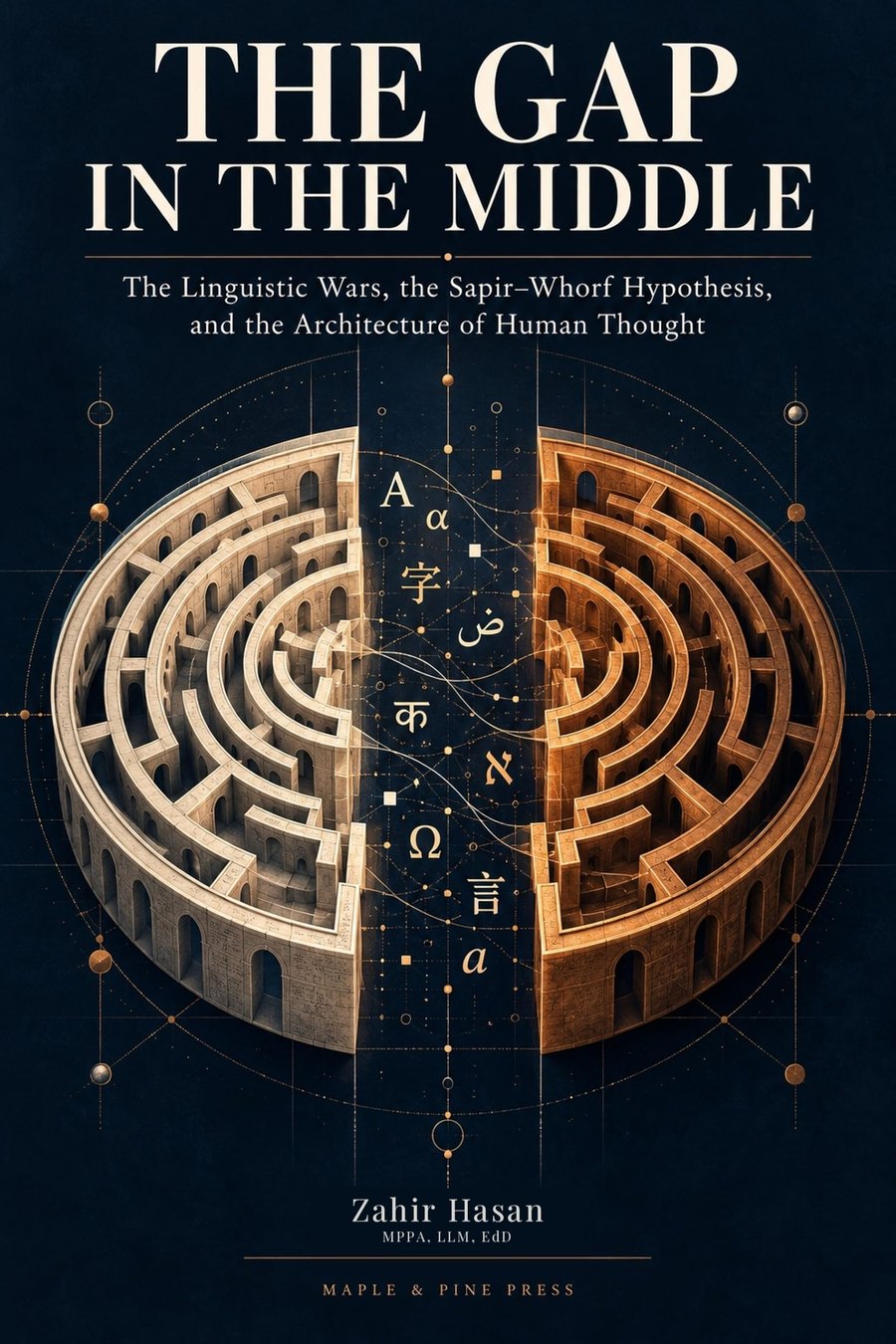
The Gap in the Middle
The Linguistic Wars, the Sapir-Whorf Hypothesis, and the Architecture of Human Thought
In 2007, researchers sat Russian and English speakers in front of three blue squares and asked them to point at the odd one out. The Russians were faster by about the time it takes to blink, twice. That sliver of time has since been asked to prove that language decides what the world looks like to us.
The Gap in the Middle is about the distance between what an experiment showed and what the headline said it showed.
Dr. Zahir Hasan works through the evidence on colour, space, time, number, memory, bilingualism and the brain, and follows the argument into classrooms, institutions, translation and artificial intelligence. Along the way: a fire inspector who noticed that the word "empty" on a petrol drum had organised somebody's attention badly; the researcher who published the universalist result in 1969 and the relativist one in 1984, with good evidence both times; three men whose grammar had been destroyed and who could still do nested arithmetic; and a bilingual advantage that dissolved under 891 effect sizes.
The book's proposal is a framework of conditional influence: name the linguistic resource, name the cognitive operation, state the conditions, and say how far the conclusion travels. It is a careful account of how language can matter without becoming a prison for the mind.
Ebook and paperback · Maple & Pine Press
- Author
- Dr. Zahir Hasan
- Publisher
- Maple & Pine Press, Tokyo
- List
- Education & Practical Guides